
Verified Springfield Township City Directory Collections
The available Springfield Township historical-directory trail is a group of documented sources, rather than one proven municipal series. The Springfield Township Historical Society archives identify telephone books, directories, maps, deeds, newspapers, organization records, and yearbooks among their local materials. The County Recorder supplies the longer property trail. The Free Library adds in-building genealogy access. Together, these sources can place a person, a property, or a road name in a dated context, but they should not be described as a complete Township household list.
| Verified material | Documented dates | Holding route | How it helps |
|---|---|---|---|
| County deed records | 1784 forward | Montgomery County Recorder | Connects parties, book/page references, and property transfers. |
| Historical Society maps and atlases | 1792 through later map eras | Black Horse Inn archive | Shows dated roads, buildings, owners, rail lines, and place labels. |
| Local telephone books | Yellow Book 2003-2006 and 2018-2019; Verizon 2002/03 and 2005 | Historical Society archive | Provides date-bound telephone and address leads after on-site inspection. |
| Township High School yearbooks | 1945, 1947-1948, and 2024 examples | Historical Society archive | Offers school and former-classmate context, not a current resident roll. |
| Released federal census material | Released census years only | Free Library, archives, and genealogy services | Can corroborate a household on its census date. |
Begin with the source closest to the date in question. A postwar telephone-book lead may help with a recent family question. A nineteenth-century property question is more likely to start with a map, a deed reference, or County archive material. The Recorder's historical-research page also points researchers toward County, local, and state repositories when the online index is not enough.
Note: A dated subscriber, owner, or census household is evidence for that record's date, not proof of every resident at an address.
Springfield Township City Directory Gaps
Research did not verify a conventional Springfield Township city-directory publisher, year-by-year run, criss-cross directory, or digitized sample entry. It also did not establish that a local collection provides a full residential sequence. That gap is useful information. It prevents a searcher from treating a familiar directory format as though it were documented for this Township.
The Historical Society newsletter does identify a 1961 Springfield Township Businessmen's Association Business Directory, along with telephone books and directories. Those materials may offer a name, business, or address lead. Their exact entry fields have not been verified in an official digital source, so an on-site check or a PastPerfect catalog inquiry should come before claiming that an entry lists an occupation, spouse, ownership mark, or household.
Springfield Township Archive Research Route
The Historical Society keeps its archives in two rooms at the Black Horse Inn, 1432 Bethlehem Pike in Flourtown. Its collection combines Colonial tax records, property deeds, owner-labelled map books, local photographs, newspapers and microfilm, telephone directories, organization records, and school yearbooks. Much of the material is physical. The Society asks visitors to call 215-233-4600 or email archives@springfieldhistory.org before a visit. Archives hours are Wednesday 1-5 p.m. and Saturday 9 a.m., with appointments available outside those times.
The Historical Society archives page shows the local collection and the research route that supports Springfield Township city directory work.
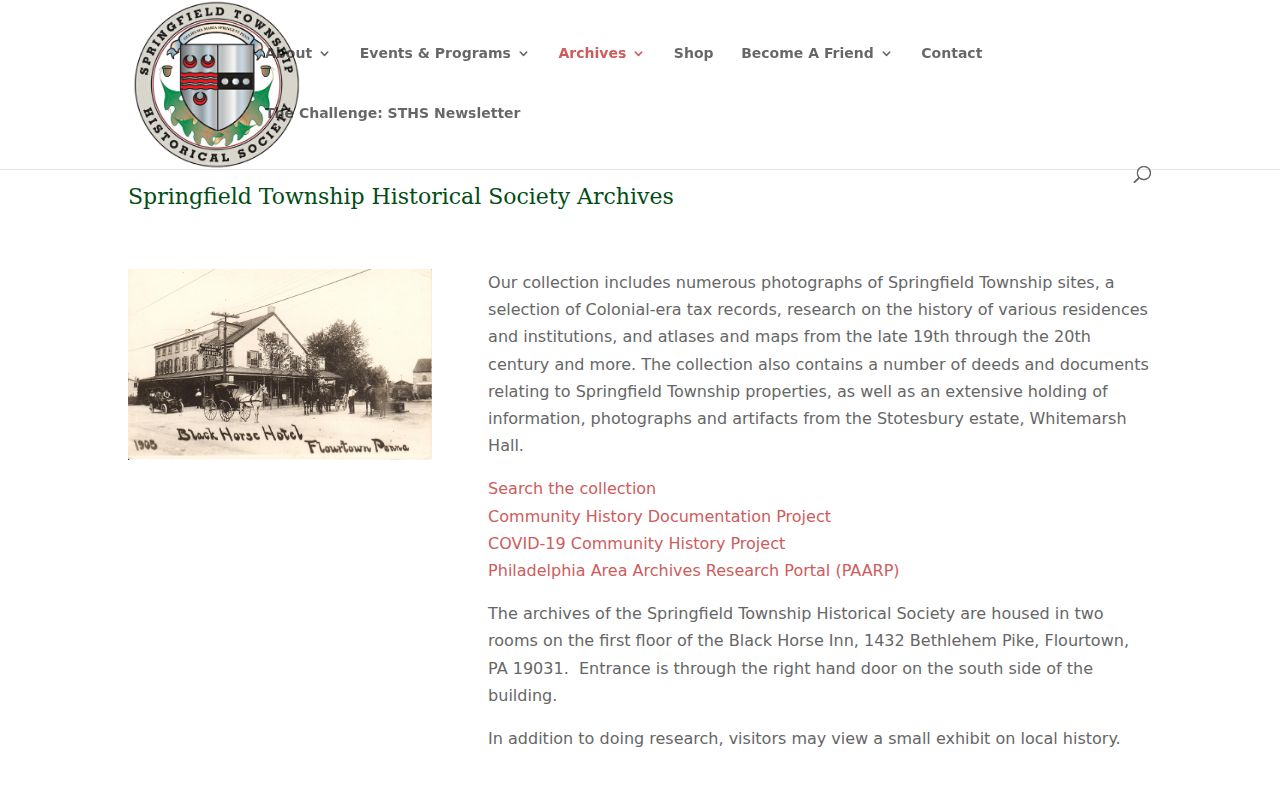
The archive is especially useful when a catalog clue needs staff help, a map needs to be compared with a deed, or a physical telephone book must be read directly.
Its online collection search is a useful first contact point. A search result signals that a related item may exist, not that the full material is online or that its contents establish a household.
The collection-search doorway is shown on the Historical Society collection page.
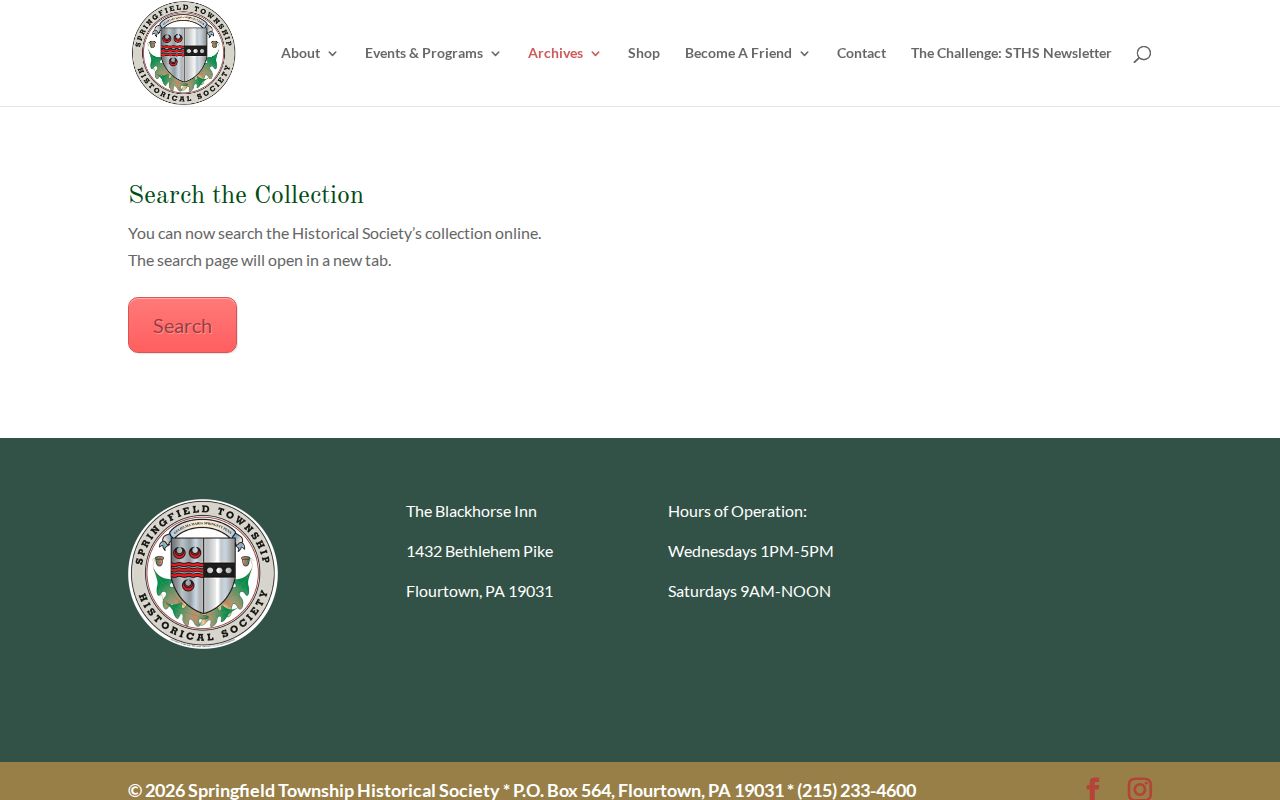
Using the catalog before an appointment makes it easier to ask for a particular road, family name, map era, telephone-book title, or yearbook.
Springfield Township City Directory Map Clues
Historic maps can solve a problem that an annual directory cannot solve when an old street name differs from today's name. The Historical Society records that the road now known as Paper Mill Road was labelled as the road toward Willow Grove on an 1855 map. An 1860 map calls Church Road "Cherry Road." The collection also includes maps labelled Flour Town and Flower Town, plus landowner and building maps from several eras.
| 1792 | A Springfield map begins the documented local map sequence. |
|---|---|
| 1855 | Paper Mill Road appears as the road toward Willow Grove. |
| 1860 | Church Road is labelled Cherry Road. |
| 1909 and 1949 | Property atlases supply later dated property context. |
| 1946 | A Franklin street and business-occupancy atlas is documented in the collection. |
Maps need a second check. The Society cautions that historical maps can show proposed roads that were never built and deliberate copyright-trap errors. Compare the street label with a deed book/page, legal description, parcel reference, or a second map before deciding that a person or property was at the same location.
Note: Historic road names are search aids, not automatic address conversions; a current parcel identifier cannot replace an older legal description.
Reading Springfield Township Directory Clues
No verified local city-directory sample establishes the usual field layout. For that reason, the safe inventory is about what the documented local materials can indicate after inspection, rather than a fictional model entry. A telephone book can point to a dated subscriber and address. A map can label an owner or building. A deed identifies transaction parties. A census names a household on census day. None of those sources substitutes for the others.
| Telephone-book lead | May connect a subscriber with a telephone/address era once the physical item is checked. |
|---|---|
| Map label | May show an owner, building, road, or place label for the map's date. |
| Deed reference | Records grantor, grantee, record type, book/page, and related property trail. |
| Census return | Places a household in a released federal census for a specific census date. |
- Criss-cross directory
- A street-ordered directory that may list addresses before names. No Springfield Township criss-cross run was verified in this research.
- Householder index
- An index organized around the named household contact. Its presence in a local item must be checked in the item itself.
- Abbreviation key
- A volume's guide to shorthand marks. No local city-directory key was verified, so do not infer one.
Springfield Township City Directory Library Path
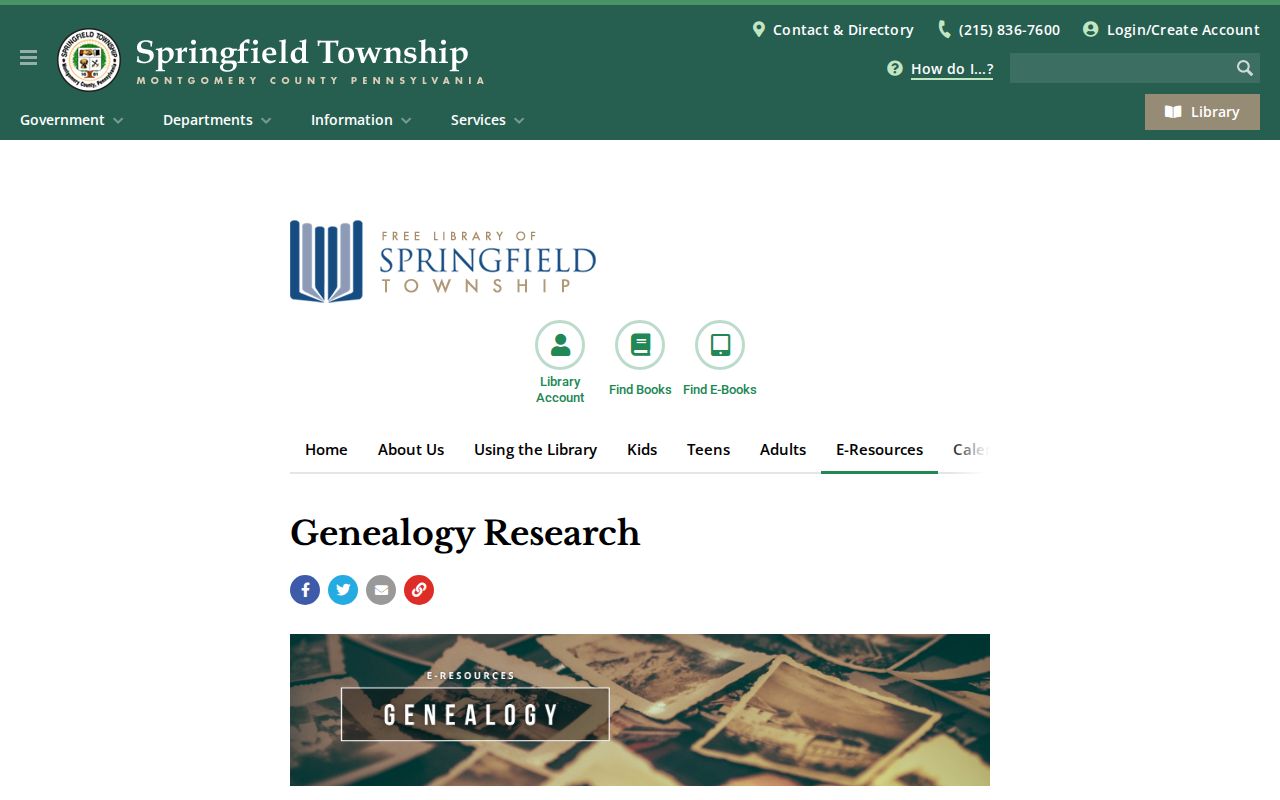
The Free Library of Springfield Township genealogy service provides Ancestry Library Edition inside the building. Its resources include birth, death, immigration, military-service, and census material. Call staff or use the catalog to ask about interlibrary loan for Philadelphia-area directories, telephone books, or yearbooks. The research did not verify a fixed Township directory shelf at the Library.
The Library is at 8900 Hawthorne Lane in Wyndmoor and lists 215-836-5300. Its published schedule is Monday through Thursday, 9 a.m.-9 p.m.; Friday, 9 a.m.-5 p.m.; Saturday, 10 a.m.-2 p.m.; and Sunday closed. Ancestry access is inside the building only. That makes a catalog question or a call to staff worthwhile before relying on a trip for one particular surname, newspaper title, telephone book, or census household.
The Library genealogy page documents the in-building research route that can support a Springfield Township city directory lead.
For a broader County context, the Historical Society of Montgomery County in Norristown holds family histories, religious records, County and town histories, research files, tax records, and Norristown Times Herald microfilm. Its online Name Database is a converted physical card catalog that points toward digital scrapbook material available on site. Its digital-newspaper holdings include Olive Branch, 1851-1857, and National Defender, 1856-1900. Confirm Township coverage with the repository before treating a newspaper result as local.
Using Springfield Township City Directories Carefully
City directory research in Springfield Township works best as a dated household reconstruction. Start with a known person, property, or road label and keep the source date beside each finding. A confirmed local telephone book, yearbook, map, or archive item can then be paired with a released census return and the deed trail. The historical collections themselves are different from the current address workflow available through the Springfield Township streets reference.
- Search the Historical Society catalog or call with the name, street, and approximate period.
- Inspect the physical item or obtain staff confirmation of its date and entry format.
- Record the exact wording, address, map label, or subscriber information without expanding it into an unsupported household claim.
- Pair the dated clue with a released census year, deed book/page, or another independent source.
- Use the Recorder, County Archives, or a historical repository when the local item ends the trail.
A person disappearing from one source does not establish why. They may have moved, used a different name form, lacked a listing, or simply fall between dated sources. The careful conclusion is the narrow one: what that particular record shows at that time.
Springfield Township Owners and Households
The documented collections make a useful comparison. A deed ties grantor and grantee to a transaction. An owner-labelled atlas can identify who a map credited with a property. A telephone directory can identify a subscriber. A census can name a household on census day. These records overlap, yet they answer different questions.
The County's land record reaches to 1784, while local maps, telephone books, school materials, and census access supply household context in only their particular eras. Use the dates to connect them, and retain uncertainty where the record does not name an occupant.
Montgomery County separated from Philadelphia County in 1784, the year the Recorder was created. No official evidence in the researched sources shows a courthouse fire, flood, or wholesale loss that erased the local record trail. A missing name therefore calls for another route, date, spelling, map label, or repository before it is treated as a lost record.